Whether you are chasing athletic performance or simply want to move better in daily life, focusing on the best quad exercises can transform your lower body strength and stability. Your quadriceps, made up of four powerful muscles along the front of your thighs, are key to knee extension, hip stability, and explosive movement. When you target them effectively, you improve everything from sprint speed to climbing stairs with ease. Below, you will discover why strengthening your quads matters so much, followed by ten of the best exercises for balanced quad development. Let’s dive in.
Discover why stronger quads matter
Your quads do more than help you stand up from a chair. They also:
- Provide stability for daily activities like walking and bending.
- Support your knee joints to help prevent injury.
- Supply essential propulsive power when sprinting or jumping.
- Contribute to better posture, as they keep your hips and knees properly aligned.
Recent fitness research highlights the importance of balanced quad work. Each of your four quadriceps muscles—Rectus Femoris, Vastus Lateralis, Vastus Medialis, and Vastus Intermedius—plays a slightly different role. For example, the Rectus Femoris crosses both your hips and knees, assisting in hip flexion and knee extension, while the Vastus Lateralis is the largest muscle on the outer portion of your thigh and contributes to overall knee stability. By training all four, you can maintain better balance, reduce injury risk, and build that signature “sweep” on the outer thigh (sometimes called quad “width”).
You might think your everyday jog or occasional squats are enough, but to really see progress, you need strategic, targeted exercises that fully engage the quads. Below are ten of the best quad exercises you can include in your routine, complete with tips on how to get the most out of each movement.
Perform these 10 exercises
1. Bodyweight squats
Bodyweight squats are a staple for leg strength because they teach you to fully control your body through hip and knee flexion. According to Healthline, these are considered one of the best all-around exercises for building lower body and core strength [1].
How to do it:
- Stand with feet roughly shoulder-width apart.
- Keep your torso upright and engage your core.
- Lower your hips back and down as though you are sitting into a chair.
- Aim to keep your knees tracking over your toes.
- Push through your entire foot to return to standing.
Beginners can reduce how far they squat (partial squats) to limit the stress on their knees and hips, while advanced exercisers can slow the downward phase to increase time under tension. You can also combine bodyweight squats with a brief pause at the bottom of the movement to maximize quad activation.
Why it works:
- Teaches proper squat mechanics.
- Strengthens the quads, hips, and core.
- Accessible anywhere with no equipment.
Recommended sets and reps:
- Aim for 3 sets of 12 to 15 reps.
- Rest 60 seconds between sets.
2. Bulgarian split squats
Bulgarian split squats emphasize each leg independently, targeting quads, hamstrings, hips, and core. By placing one foot behind you on a bench or step, you increase the workload on your front-leg quadriceps. Research suggests they also engage important stabilizing muscles around your knee and hip [1].
How to do it:
- Stand a couple of feet in front of a stable bench with your back to the bench.
- Lift one foot behind you and rest your instep on the bench.
- Keeping your torso upright, lower your body by bending your front knee.
- Press firmly through the front foot to return upright.
You can limit squat depth to make it easier or use dumbbells to make it harder. Focus on knee tracking: keep your front knee in line with your toes.
Why it works:
- Corrects muscle imbalances by isolating each leg.
- Strengthens your quads and stabilizers around the knee.
- Improves balance and core engagement.
Recommended sets and reps:
- Try 3 sets of 8 to 10 reps per leg.
- Rest 60 to 90 seconds between sets.
3. Walking lunges
Walking lunges build lower body strength by emphasizing the quadriceps, hamstrings, glutes, and core. According to Healthline, you can add dumbbells once you feel confident in your form, making them a versatile exercise for various fitness levels [1].
How to do it:
- Stand tall with feet hip-width apart.
- Step forward with your right foot, bending your knee to about 90 degrees.
- Keep your torso upright and your front knee aligned over your toes.
- Push through your right foot, and bring your left foot forward into your next lunge.
- Continue “walking” forward for the prescribed number of steps.
Try to maintain a steady, controlled tempo throughout. If balance is a challenge at first, keep your hands on your hips or practice in place until you feel stable.
Why it works:
- Targets multiple lower body muscles, especially your quads.
- Encourages better core activation and balance due to the dynamic nature of the exercise.
- Easily scalable with added resistance or fewer rest breaks.
Recommended sets and reps:
- 2 to 3 sets of 10 to 12 lunges per leg.
- Rest 60 seconds between sets.
4. Leg press with low foot placement
Placing your feet lower on the leg press platform increases knee flexion, shifting a bigger portion of the load onto your quads. According to Gymshark, this movement allows for heavier lifts while providing back support, making it a go-to exercise for serious quad growth [2].
How to do it:
- Adjust the seat so that your lower back stays supported.
- Position your feet toward the lower half of the platform, approximately shoulder-width apart.
- Unlock the sled and lower it slowly, maintaining control as you bend your knees.
- Avoid letting your lower back round off the seat.
- Press the platform away, prioritizing an even push through both feet.
Keep your knees aligned with your toes to reduce stress on your joints. Overloading is easier here than with free weights, but always start with a moderate weight and progress slowly.
Why it works:
- Allows a heavier load for serious quad development.
- Provides back support and reduces hip involvement.
- Helps isolate the quadriceps.
Recommended sets and reps:
- Perform 3 to 4 sets of 8 to 12 reps.
- Rest 90 seconds between sets.
5. Barbell front squats
Barbell front squats shift the weight to the front of your body, forcing you to maintain an upright torso. This upright position increases knee extension demands, giving your quadriceps a serious workout. Verywell Health notes that front squats place less load on your knees and back once you master the proper form compared to traditional back squats [3].
How to do it:
- Set the barbell on a squat rack at about shoulder height.
- Position the bar across the front of your shoulders, crossing your arms or using a clean grip with elbows up.
- Step back and set a shoulder-width stance.
- Keep elbows lifted as you lower into the squat.
- Push through your full foot to return to standing.
If you are new to barbell front squats, practice with an empty bar or even a lighter alternative like a PVC pipe to become comfortable with the front rack position.
Why it works:
- Emphasizes the quads by keeping your torso upright.
- Improves core strength as you fight to maintain posture.
- Builds overall lower body power.
Recommended sets and reps:
- 3 sets of 5 to 8 reps.
- Rest 90 seconds to 2 minutes between sets.
6. Heel-elevated goblet squats
By elevating your heels slightly on a weight plate or slant board, you shift more load to the quads. Goblet squats also lessen pressure on your lower back because you hold a single dumbbell or kettlebell in front of your chest. According to Gymshark, heel elevation helps reduce ankle mobility issues so you can squat deeper and target the quads more effectively [4].
How to do it:
- Stand with your heels on a small plate or wedge, toes on the floor.
- Hold a kettlebell or dumbbell at chest level.
- Keep your chest upright and engage your core.
- Squat down by bending your knees and sitting back slightly.
- Push through your entire foot to return to standing.
This variation not only activates your quads but also helps you achieve greater squat depth if tight ankles usually hold you back.
Why it works:
- Increases knee flexion to emphasize the quads.
- Eases strain on the lower back by shifting the load forward.
- Improves squat depth and form for those with limited ankle mobility.
Recommended sets and reps:
- Start with 3 sets of 10 reps.
- Rest 60 to 90 seconds between sets.
7. Hack squats
Hack squats are performed on a specialized machine that supports your back and shoulders, placing intense focus on the quads. Online fitness communities often rank hack squats high for their ability to isolate and overload your quadriceps. Many lifters also note significant improvements in quad strength and size from consistent hack squat training [5].
How to do it:
- Position your back and shoulders flat against the machine.
- Place your feet shoulder-width apart on the platform, with knees in line with the toes.
- Release the safety handles or locks.
- Lower yourself down under control, aiming for a deep knee bend.
- Press back up smoothly, avoiding locking out your knees at the top.
You can do variations with feet closer together or lower on the platform to shift even more emphasis onto the quads. Just be mindful of going too low if it leads to any knee discomfort.
Why it works:
- Machine support allows you to focus on pushing your quads hard.
- Encourages deep knee flexion for greater muscle recruitment.
- Ideal for building size and strength without too much core instability.
Recommended sets and reps:
- 3 sets of 8 to 12 reps.
- Rest 60 to 90 seconds between sets.
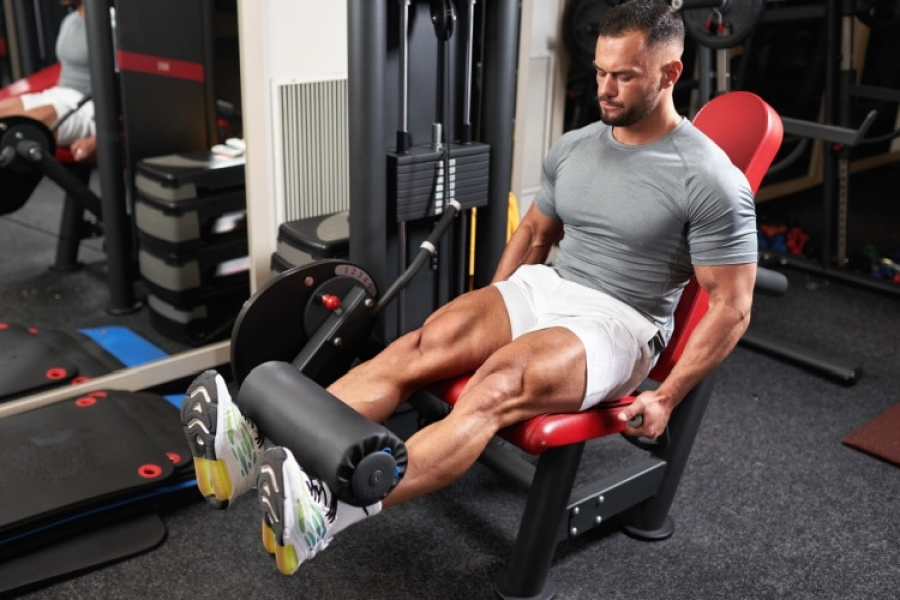
8. Leg extensions
Leg extensions are arguably the most direct isolation exercise for the quadriceps. According to Gymshark, these are perfect for finishing workouts or training more frequently without as much systemic fatigue [6].
How to do it:
- Adjust the machine so the pad rests just above your ankles.
- Sit with your knees at about 90 degrees.
- Extend your legs until they are parallel with the floor, squeezing your quads.
- Lower the weight slowly and repeat.
To add variety, you can do single-leg extensions to focus on each side. This can help correct strength and size imbalances.
Why it works:
- Directly isolates your quads without heavy loads on your spine.
- Allows higher volume or frequency due to easier recovery needs.
- Great finisher to pre-fatigue or completely burn out the quads.
Recommended sets and reps:
- 2 to 3 sets of 10 to 15 reps.
- Rest 45 to 60 seconds between sets.
9. Single-leg raises
Single-leg raises target the Rectus Femoris more heavily, especially since you are lifting the thigh against gravity while keeping the knee in extension. They also engage hip flexors and help learners understand how to isolate quads with minimal equipment [1].
How to do it:
- Lie on your back with one leg bent and the other extended.
- Contract your quads in your extended leg.
- Slowly raise that leg until it is about level with your bent knee.
- Keep your core tight to protect your lower back.
- Lower the leg under control and repeat.
You can place a small ankle weight around the working leg for an added challenge. Even though this is a simpler movement, you may feel a focused burn in your quads quite quickly.
Why it works:
- Isolates the Rectus Femoris and hip flexors.
- Protects your joints with a small range of motion.
- Ideal for beginners, those rehabbing injuries, or as a supplemental exercise.
Recommended sets and reps:
- 2 sets of 12 to 15 reps per leg.
- Rest 30 to 45 seconds between sets.
10. Sissy squats
Sissy squats create a powerful stretch and contraction in your quads by allowing your knees to track far forward as your torso leans back. This position heavily emphasizes the knee extension action. Because of the angle, they can be challenging on the knees, so you should advance to them slowly.
How to do it:
- Stand with feet at hip-width, perhaps bracing against a stable surface for balance.
- Rise onto the balls of your feet.
- Keeping your core tight, hinge from your knees so that they travel forward as your upper body leans back.
- Lower until you feel a strong stretch in your quads, then return to the start.
If you are new to sissy squats, perform them with partial range or use a support such as a squat rack or stable wall to hold onto. This is an advanced move, so scale carefully to avoid knee stress.
Why it works:
- Places intense stress on the quads through deep knee flexion.
- Builds functional knee stability if done with good control.
- Provides an advanced burn for seasoned lifters.
Recommended sets and reps:
- 2 to 3 sets of 6 to 10 reps.
- Rest 60 seconds between sets.
Structure your quad workouts
Adding these ten movements into your weekly plan requires a strategic approach. Here are some guidelines to get the most out of your quad training:
Frequency and volume
- Aim to train your quads at least twice a week for optimal growth.
- Research suggests performing a minimum of 10 sets per week, split across these sessions [4].
- Spread out your quad work so you allow at least 48 hours of recovery between sessions.
Exercise selection
- Pick one or two compound exercises, such as front squats, hack squats, or Bulgarian split squats.
- Choose one or two isolation movements like leg extensions or single-leg raises to finish strong.
- Mix up foot positions (e.g., low foot placement on the leg press) to challenge your quads from different angles.
Reps and sets
- For muscle hypertrophy, aim for 8 to 12 reps per set on your main lifts.
- Go slightly higher—12 to 15 reps—for single-joint work, like leg extensions.
- Rest intervals of around 60 to 90 seconds tend to balance strength gains with muscular endurance.
Progressive overload
- Increase weight, reps, or time under tension over the weeks.
- Keep track of your progress so you can maintain steady growth.
- Avoid rushing. Quality form is more important than cranking out sloppy reps.
Recovery
- Quads can be prone to delayed onset muscle soreness (DOMS), especially after new or demanding exercises.
- Incorporate light stretching, foam rolling, and adequate nutrition to help speed recovery.
- If very sore, adjust the intensity or focus on lighter movements until you are ready for heavier loads again.
Consider these final tips
Achieving stronger, more defined quads does not have to be complicated, but it does take consistency and careful progression. Here are a few final tips to keep in mind:
- Prioritize your technique. Even if you are lifting lighter weights, a full range of motion and proper alignment (knees tracking over toes) will bring better results over time.
- Warm up thoroughly. Fire up your quads with dynamic moves, such as leg swings or gentle bodyweight squats, before your heavier lifts.
- Listen to your body. If you feel knee discomfort, reduce depth or switch to a movement that keeps you pain-free. Over time, you can build strength and stability to handle deeper angles.
- Integrate core work. Planks or anti-rotation exercises help stabilize your trunk so you can maintain excellent form in quad movements like front squats or Bulgarian split squats.
By combining a handful of these best quad exercises, refining your form, and gradually increasing the challenge, you set yourself up for real progress in strength, speed, and daily functionality. Build your plan, stay consistent, and watch your quads become a powerful asset whether you are sprinting on the track or carrying groceries up the stairs. The payoff—strong, stable legs—will serve you for years to come. Keep going and stay focused. Your stronger quads are waiting.
References
- (Healthline)
- (Gymshark)
- (Verywell Health)
- (Gymshark)
- (Reddit)
- (Gymshark)