If you are looking for the best glute exercises to strengthen and shape your lower body, you’re in exactly the right place. Whether you spend much of your day sitting or want an edge in your athletic pursuits, strong glutes can help you move more efficiently, support healthy posture, and reduce injury risk. In fact, research shows that glute training boosts your hip stability, enhances day-to-day tasks like lifting objects, and improves sports performance—even without the need for heavy weights [1].
This guide will walk you through 10 of the most effective moves for your glutes. You’ll also see how to use them in a simple plan you can follow at home or in the gym. Each exercise targets the three main muscles that make up your glutes: the gluteus maximus, medius, and minimus. By learning how to engage each one, you can build a well-rounded base of strength and functionality.
Read on, and you’ll discover how consistently training with these movements can help you see noticeable changes in four to six weeks, especially if you’re new to glute workouts. You’ll also learn tips on frequency, form, and warm-ups, along with insights from fitness experts at Healthline, Planet Fitness, Peloton, and more. Let’s dive into why training your glutes should be a top priority, then get into the specifics of each exercise.
Why strong glutes matter
Your glutes are the largest muscle group in your body, making them a big driver of power, balance, and stability. Every time you walk, climb stairs, bend to pick something up, or simply stand upright, your glutes help handle the load. Strengthening them delivers benefits that go beyond aesthetics. Here are three key reasons to make glute work a fixture in your fitness routine:
-
Everyday functionality: If you ever commute by foot, carry groceries, or even just transition out of a chair, your glutes are front and center. According to a 2025 Planet Fitness guide, the gluteus maximus, medius, and minimus stabilize your hips and spine, reducing strain on your lower back [2].
-
Sports performance: Running, cycling, and many other sports hinge on your capacity for hip extension and rotation. Well-developed glutes can help you generate more power, sustain speed, and maintain better form. This also decreases your likelihood of knee and hip injuries from repetitive impact.
-
Posture and pain reduction: Weak glutes often correlate with low back discomfort, especially if you spend long periods sitting. By actively strengthening your glutes, you support your pelvis in a more neutral position, easing stress on your lower spine.
When you train your glutes consistently—two to three times per week—you may also see improved muscle tone, better core stability, and increased confidence in your movement.
How to approach your glute training
Before you jump into the exercises, keep a few best practices in mind to maximize results and reduce risk of injury.
Aim for consistency and rest
According to Planet Fitness guidelines, beginners can train glutes two or three times a week, with rest days in between [2]. This schedule gives your muscles time to repair and grow. If you’re more advanced, you can schedule glute sessions up to three times per week, balancing volume and intensity carefully.
The mistake many people make is hitting the same exercises daily without rest, thinking more is always better. Muscles strengthen when they recover—so remember to schedule downtime for your glutes to replenish.
Start with a proper warm-up
A hydrated and warmed-up muscle is far more receptive to training than a stiff or sedentary one. Just 10 minutes of light cardio—like brisk walking or moderate jogging—can prime your body for glute-targeted exercises, particularly if you’re new. Healthline notes that a brief warm-up boosts blood flow and prepares your body for more intense training [3].
This is also a good time to include simple glute activation drills. For example, you could do a quick set of bodyweight squats or donkey kicks to get your hips engaged. Peloton instructors often recommend glute activation exercises before running or cycling, especially if you tend to rely heavily on your quads [4].
Focus on progressive overload
If you want to see real gains in muscle size or strength, progressive overload is the key. That means occasionally increasing volume (reps or sets) or complexity (adding a pause, changing tempo) to sustain muscle growth. Even when working with just your body weight, you can raise difficulty by slowing down reps, adding mini-holds, or reducing rest times in your sets. Over time, these small adjustments compel your glutes to adapt.
1. Squats
Squats are a gold-standard lower-body move for a reason. They activate nearly your entire lower half, with an emphasis on the gluteus maximus. As you drive up from the squat’s lowest point, you press your hips forward, engaging your glutes and quads to support the movement.
- How to do it:
- Stand with your feet about hip-width apart.
- Keep your chest tall and look forward.
- Slowly bend your knees, pushing your hips back as though you’re about to sit in a chair.
- Continue lowering until your thighs are parallel (or nearly parallel) to the ground.
- Press through your heels to return to standing, keeping your core braced.
- Tips for effectiveness:
- Go slow and controlled. Research from Healthline emphasizes that controlling your movement can help you target the glutes more effectively.
- If you’re advanced, you can progress by adding resistance bands around your thighs, or performing single-leg variations.
2. Glute bridges
Glute bridges focus on hip extension—one of the main functions of the gluteus maximus. They also activate your hamstrings, lower back, and core. According to Cleveland Clinic, supine bridges engage your entire gluteal region, and you can even hold a small weight across your hips for extra resistance once you’re ready [5].
- How to do it:
- Lie on your back, knees bent, and feet flat on the floor, hip-width apart.
- Keep your arms by your sides, palms down.
- Push through your heels, lifting your hips until your body forms a straight line from shoulders to knees.
- Squeeze your glutes and pause for one or two seconds at the top.
- Slowly lower your hips back toward the floor without letting them rest completely, then start your next rep.
- Tips for effectiveness:
- Position your feet so you feel your glutes working more than your quads.
- Add a resistance band above your knees or place a small weight on your lap to introduce progressive overload.
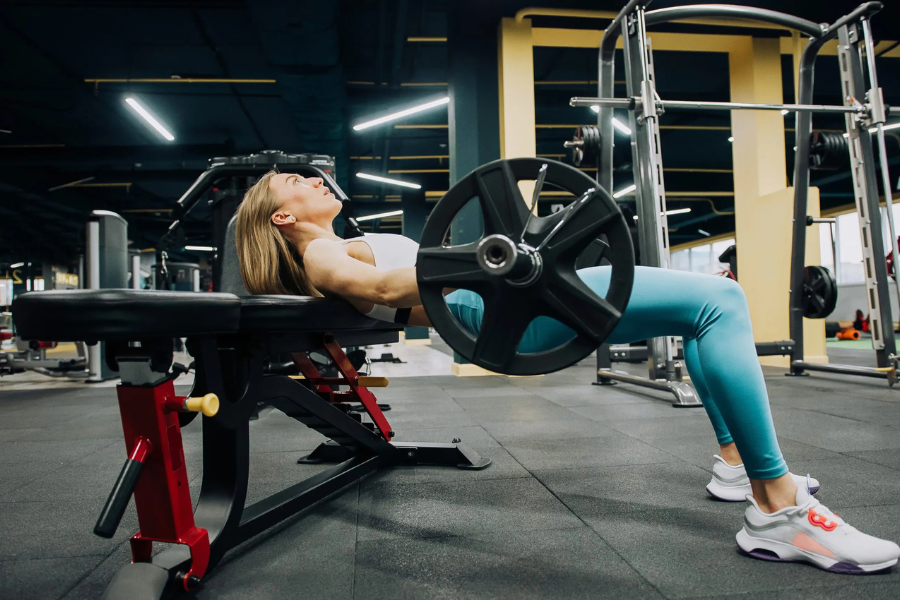
3. Hip thrusts
Similar to glute bridges, hip thrusts primarily target your gluteus maximus but also engage the medius and minimus for overall strength. Jeff Cavaliere from ATHLEAN-X calls the barbell hip thrust one of the best moves for hypertrophy because it moves your hips through a more complete range of motion [6]. You can do hip thrusts with just your body weight, a barbell, or a resistance band.
- How to do it:
- Sit on the floor with your upper back against a bench or stable couch edge.
- Bend your knees so your feet are flat on the ground, hip-width apart.
- Rest a barbell or cushion (optional) across your lap.
- Drive through your heels, lifting your hips until your torso is parallel to the floor.
- Squeeze your glutes at the top, then lower your hips slowly.
- Tips for effectiveness:
- Keep your chin tucked and your ribs down so your spine stays neutral.
- Pause for a brief count at the top to ensure full glute engagement.
4. Split squats
Split squats are a unilateral (single-leg) exercise that will challenge your balance while heavily targeting your glutes, quads, and hamstrings. This movement can also reveal muscle imbalances—often one side will feel more stable than the other.
- How to do it:
- Stand in a staggered stance, one foot forward and the other foot back on the ball of your foot.
- Bend both knees, lowering your hips in a controlled manner.
- Once your back knee is close to the ground, press through the heel of your front foot to stand back up.
- Keep your torso upright and your core tight throughout.
- Tips for effectiveness:
- Adjust the width of your stance so you can drop straight down.
- If you’re new, start by holding onto a wall or stable object for balance.
5. Curtsy lunges
The curtsy lunge places a unique emphasis on your glute medius and minimus by moving your leg diagonally. This lateral approach helps build hip stability. ATHLEAN-X notes that curtsy lunges effectively place demands on the hip abductors, which many traditional forward-and-back exercises overlook [6].
- How to do it:
- Stand with feet hip-width apart.
- Step your right leg behind your left leg, crossing midline as if you were doing a curtsy.
- Bend both knees and lower your hips, keeping your chest and shoulders facing forward.
- Return to standing and repeat on the other side.
- Tips for effectiveness:
- Keep your weight in the front heel.
- Go slow to avoid twisting your torso. Aim for steady alignment so your hips and knees track safely.
6. Single-leg Romanian deadlifts
Single-leg Romanian deadlifts target the gluteus maximus and hamstrings while also firing up the gluteus medius for balance. Gymshark ranks single-leg RDLs as one of the best bodyweight moves for building glute strength at home because they challenge stability in ways bilateral movements can’t [7].
- How to do it:
- Stand on your right leg, slight bend in your knee.
- Engage your core, then hinge at your hips while lifting your left leg behind you.
- Keep your back flat as you lower your torso and left leg toward the floor—it helps to look at a point in front of you.
- Squeeze your right glute to stand upright again.
- Tips for effectiveness:
- Keep your hips level (avoid opening to the side).
- If you need stability, you can lightly hold on to a sturdy surface or keep your lifted foot touching the floor at certain points.
7. Step-ups
Step-ups mimic climbing stairs and activate the gluteus maximus, medius, and minimus. Peloton experts place step-ups among the top glute exercises for building functional strength that carries over to running, hiking, and day-to-day tasks [4].
- How to do it:
- Stand in front of a sturdy bench or box.
- Place your right foot on the bench, making sure it’s fully planted.
- Drive through your right heel to bring your left foot up onto the bench.
- Step back down in a controlled manner, then repeat on the other side.
- Tips for effectiveness:
- Keep your torso upright and avoid slamming your trailing foot onto the platform.
- Aim for moderate height at first. As you gain confidence, increase the height or add dumbbells if you want more resistance.
8. Fire hydrants
Fire hydrants focus on the glute medius and minimus, which contribute to hip abduction and stabilization. Many people find these muscles underdeveloped, and building them up can support better overall hip mechanics. Cleveland Clinic warns to maintain proper form to avoid strain [5].
- How to do it:
- Start on all fours with hands under your shoulders and knees under your hips.
- Keep your core tight and back neutral.
- Lift your right knee out to the side without rotating your pelvis.
- Pause briefly, then lower to the start.
- Tips for effectiveness:
- Move slowly, focusing on using your glute to lift your leg, not your lower back.
- You can use a resistance band around your thighs for added challenge.
9. Lateral band walks
Lateral band walks (or “banded lateral walks”) build strength primarily in the gluteus medius and minimus via sideways movement. Peloton’s 2024 guide points out that placing the band around your ankles or feet increases glute recruitment further than around the knees [4].
- How to do it:
- Place a resistance band around your ankles or across the arches of your feet.
- Stand with feet hip-distance apart, slight bend in your knees.
- Take a small step to one side, feeling tension in the band and your outer hip.
- Step your other foot over to return to a hip-width stance.
- Continue for the desired number of steps, then switch directions.
- Tips for effectiveness:
- Keep constant tension on the band—avoid letting your feet snap back together.
- Maintain an athletic stance with a slight forward lean and engaged core.
10. Donkey kicks
Donkey kicks hone in on hip extension, directly challenging your gluteus maximus without tons of load on the quad. They’re an excellent addition if you primarily rely on squats and lunges but want more pure glute isolation.
- How to do it:
- Start on all fours, hands under shoulders, knees under hips.
- Flex your right foot and kick your heel straight back and up toward the ceiling.
- Keep your knee bent and your hips square to the floor.
- Pause, then slowly lower your knee.
- Tips for effectiveness:
- Engage your core to prevent leaning or arching, which can reduce the focus on your glute.
- Squeeze at the top for a second or two to amplify glute activation.
Sample workout plan
Now that you have the 10 best glute exercises, how do you put them together? Below is a sample weekly plan to establish a solid baseline of glute training for beginners or those returning to fitness. As always, adapt sets, reps, and rest intervals to your personal needs and fitness level.
Day 1 (Glute Focus 1)
- Warm-up (10 minutes): Light jog or power walk plus glute activation drills (like fire hydrants or donkey kicks).
- Squats: 3 sets of 10 reps
- Glute bridges: 3 sets of 12 reps
- Curtsy lunges: 3 sets of 8 reps per leg
- Step-ups: 3 sets of 8 reps per leg
- Cool, stretch: 5 to 10 minutes of light lower-body stretches (quads, hamstrings, glutes)
Day 2 (Active Recovery)
- Easy walk or low-intensity bike ride (20 to 30 minutes)
- Gentle hip opening stretches or yoga flow
Day 3 (Glute Focus 2)
- Warm-up (10 minutes): Dynamic stretches for hips, ankles, and core.
- Hip thrusts: 4 sets of 8 reps
- Split squats: 3 sets of 8 reps per leg
- Fire hydrants: 2 sets of 12 reps per leg
- Lateral band walks: 3 sets of 10 steps in each direction
- Cool, stretch: 5-minute gentle walk or hip opener stretches
Day 4 (Rest)
- Relax, rehydrate, and ensure you’re getting enough protein and overall nutrients.
Day 5 (Glute Focus 3)
- Warm-up (5 to 10 minutes): Moderate cardio plus donkey kicks to activate your glutes.
- Single-leg Romanian deadlifts: 3 sets of 8 reps per leg
- Glute bridges (with hold): 3 sets of 10 reps, with a 2-second pause at the top
- Donkey kicks: 2 sets of 12 reps per side
- Squats: 3 sets of 10 reps (add a band for an extra challenge)
- Cool, stretch: Hip flexor and hamstring stretches
Day 6 (Light Cardio or Active Recovery)
- Choose something gentle like a hike or an easy swim.
Day 7 (Rest)
- Let your body recover.
Progressive overload tips
To keep your muscles adapting:
- Increase the number of repetitions or sets.
- Slow down the tempo, especially on the lowering portion of each exercise.
- Add a pause at the peak contraction (common in movements like glute bridges or fire hydrants).
- Incorporate resistance bands or weights as needed to intensify the challenge.
- Shorten rest intervals to push muscular endurance.
By making these incremental changes every few weeks, you ensure your glute strength continues to grow without hitting a plateau.
Frequently asked questions
How soon will I notice a difference?
Healthline points out that effective glute workouts can yield noticeable results within one to two months if performed consistently twice a week [3]. True beginners may see changes even faster as the body responds quickly to new stimuli. Focus on steady progression, balanced nutrition, and adequate rest for best results.
Do I need equipment?
All the exercises in this list can be done with little or no equipment, and many fitness experts, including Gymshark and Planet Fitness, emphasize that bodyweight moves can be enough for glute growth [8]. Bands, dumbbells, or a barbell can adapt these exercises to your evolving strength, but you don’t have to rely on a full gym setup to see real progress.
Should I also train other muscle groups?
Strengthening your glutes is beneficial, but an overall balanced program supports better posture, movement, and injury prevention. That means including core, upper body, and other lower-body movements in your plan. Complement your glute work with exercises like push-ups, planks, and shoulder presses to ensure comprehensive fitness.
Are glute activation drills a must?
If you have trouble “feeling” your glutes working, especially in compound moves like squats, activation exercises can help. They help you kickstart the mind-muscle connection, so your glutes fire properly instead of letting your quads or hip flexors dominate. Peloton trainers suggest drills like clamshells, mini band lateral walks, and donkey kicks as part of a warm-up [4].
Can these exercises help reduce lower back pain?
While every individual is different, strong glutes generally support proper pelvic alignment, which can alleviate pressure on your lower spine. Combined with good posture habits and stretching, regular glute training can be a powerful tool for back health. If you experience chronic pain, consult a healthcare professional for personalized guidance.
Conclusion
Your glutes play a starring role in almost everything you do—from standing and walking to powering through sprints and squats. By incorporating these 10 best glute exercises into your routine, you’ll build a strong foundation for athletics, everyday activities, and overall lower body health. Whether you choose the convenience of bodyweight movements at home or opt for a more advanced setup at the gym, consistency and progressive overload will guide you toward worthwhile results.
Over the next few weeks, commit to a schedule with two or three glute-centric workouts, give your body ample rest, and track your progress. When you notice more stability in your hips, easier transitions from sitting to standing, and perhaps a visible lift in your backside—those are signs all that targeted work is paying off. A strong core, better posture, and reduced risk of lower back strain can also come along for the ride.
Now that you have clear guidance, pick a few favorite exercises from this list, plan out your training days, and get ready to feel the difference in your glutes. Keep it consistent, track your form and slow, controlled movements, and don’t forget to enjoy the confidence that comes with a stronger and more capable body. You’ve got this!
References
- (Healthline, Gymshark)
- (Planet Fitness)
- (Healthline)
- (Peloton)
- (Cleveland Clinic)
- (ATHLEAN-X)
- (Gymshark)
- (Gymshark, Planet Fitness)